

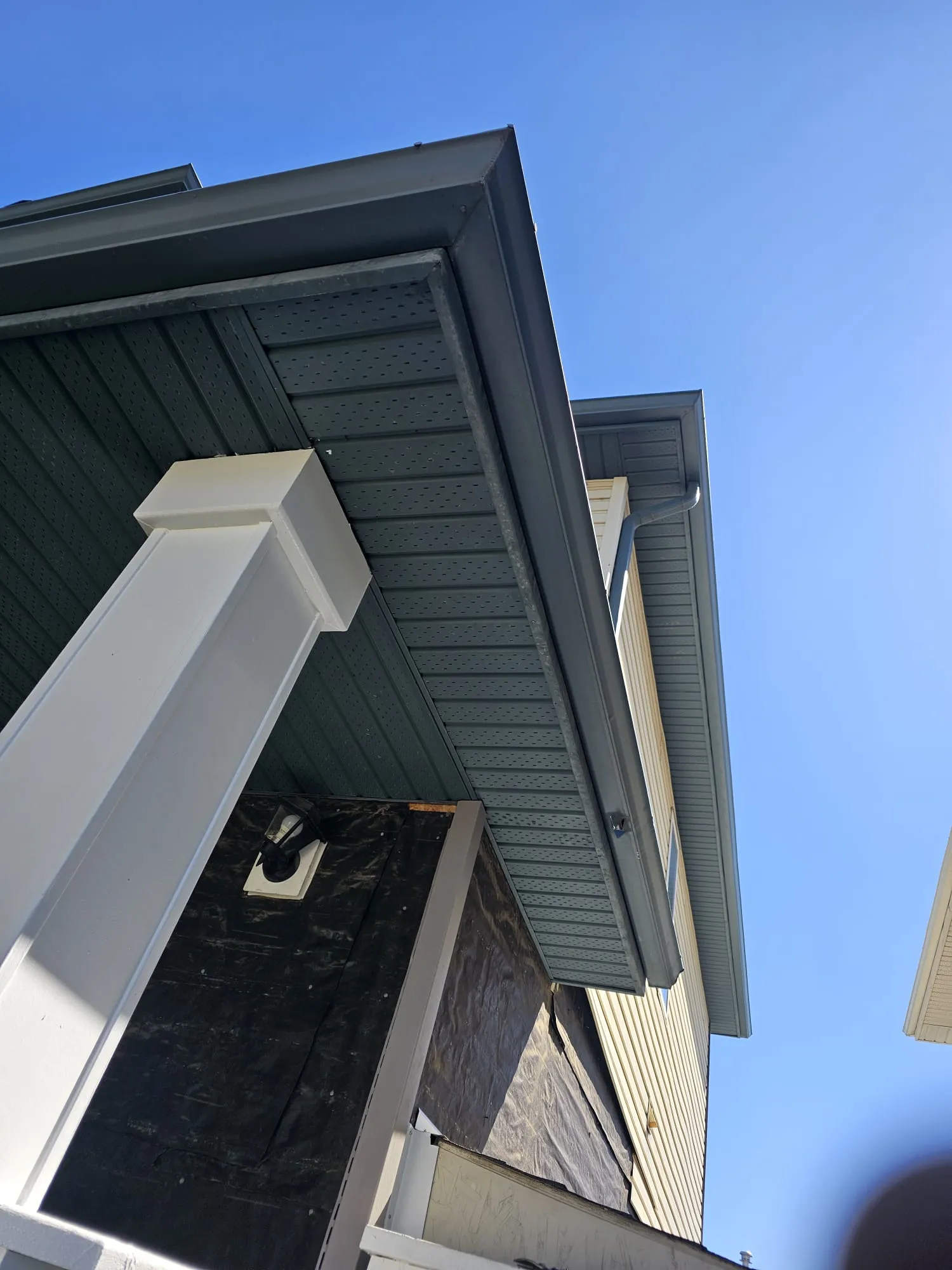
Eavestroughs · Calgary & Area
Seamless Eavestroughs
5" and 6" seamless aluminum rolled on-site to the exact length of your roofline — no mid-run joints to leak
Eavestroughs
Seamless Eavestroughs done right, the first time.
We roll seamless aluminum eavestrough on-site, cut to the exact measured length of each run, so a straight elevation gets one continuous trough with no mid-run joints to leak or clog. Hung on hidden hangers rather than spikes, pitched by measurement rather than eye, sized against your actual roof area, and discharged well clear of a foundation sitting on Calgary's clay soil.
More about eavestroughs
Built for Calgary's weather & homes.
Eavestroughs are the least glamorous part of an exterior and the one most likely to cost you real money when they fail. The job is simple and unforgiving: catch everything the roof sheds, and move it far enough from the foundation that it does no harm. On Calgary's expansive clay soils — which swell as they take on water and shrink as they dry — that distance is not a detail. It is the difference between a stable foundation and a wet basement.
Seamless eavestrough is extruded from a coil of aluminum through a roll-former mounted on our truck and cut to the exact measured length of the run it is going on. The only joints in the finished system are the sealed and riveted corners and downspout outlets. Compare that with sectional gutter from a big-box store, which arrives in ten-foot lengths and carries a joint every ten feet — four joints on a fifty-foot elevation where seamless has none.
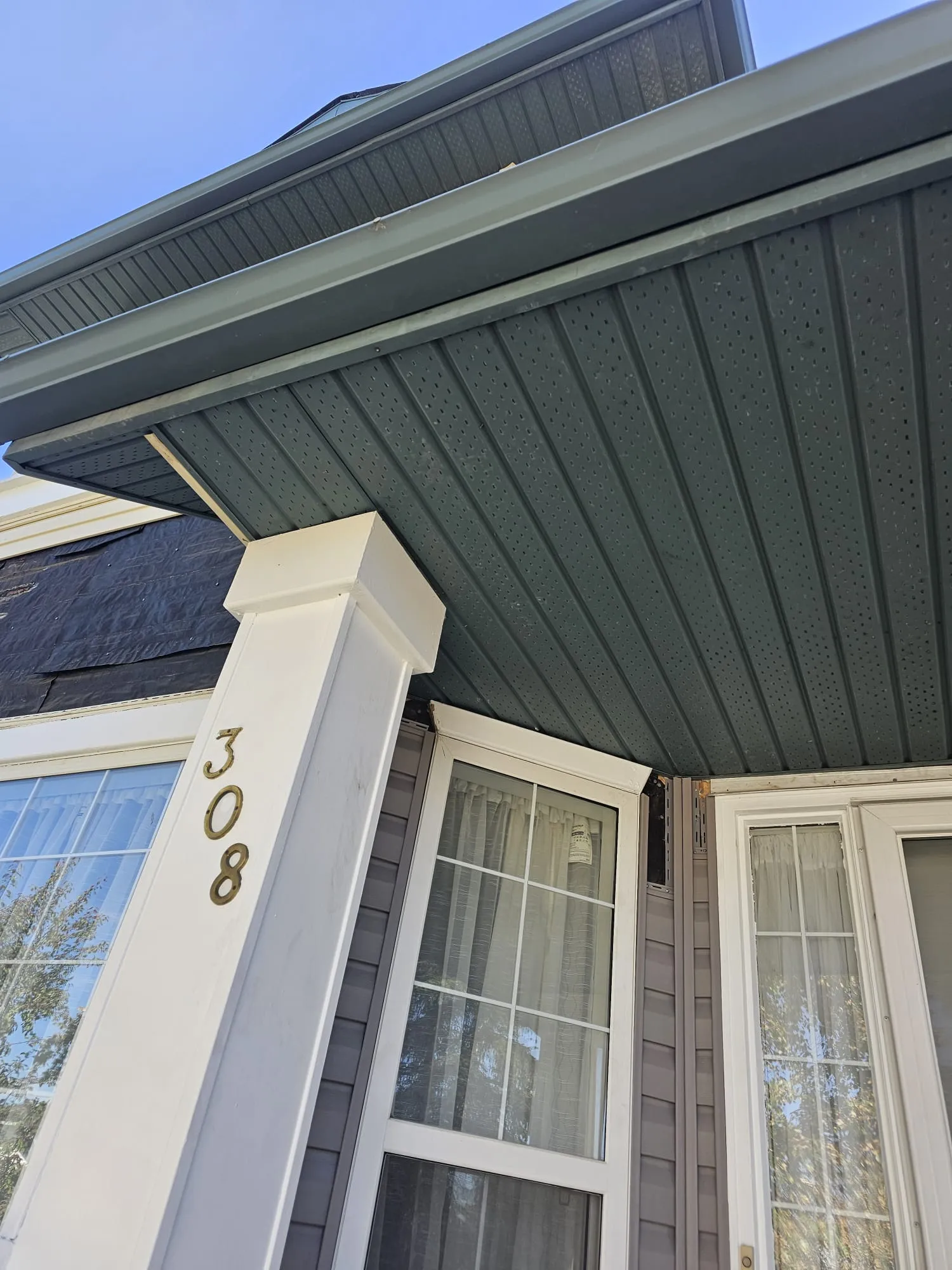
Joints are where eavestroughs fail. Sealant ages and cracks, debris catches at the lap and builds a dam, and a hard freeze pries the connection open. Removing them from the equation is the single biggest durability difference available in this product category, and it costs very little more than the sectional alternative once labour is counted.
Sizing is where most systems go wrong, and it is the question we get asked least and should be asked most. Five-inch trough handles the majority of Calgary bungalows and standard two-storeys. Six-inch moves roughly forty percent more water and is the right specification for large roof areas, steep pitches that shed fast, long runs served by too few downspouts, and the big footprints typical of acreage homes.
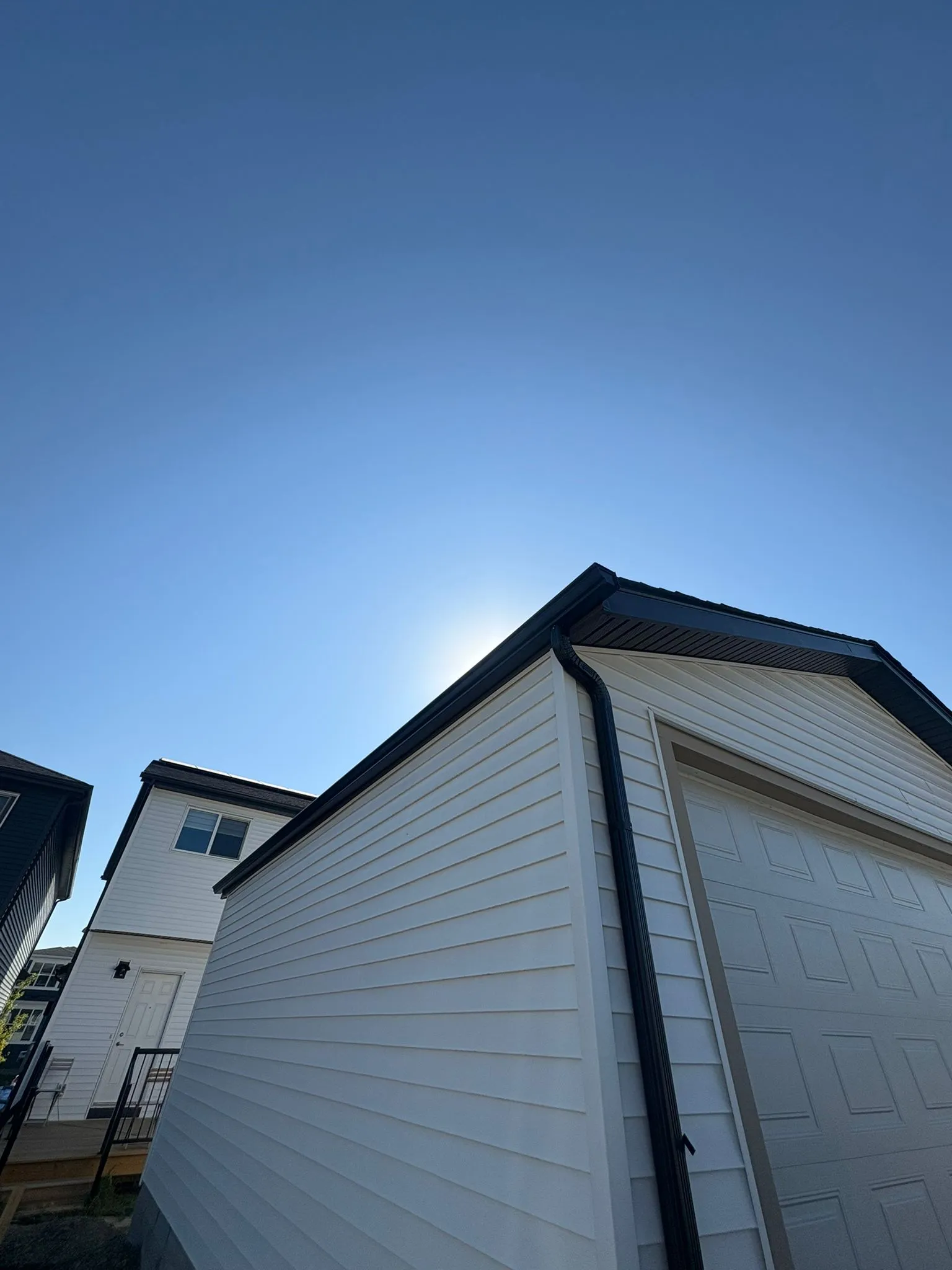
Because we also roof and install soffit and fascia, we treat the eave as one assembly. There is no point hanging new trough on rotten fascia, and no point pitching it perfectly if a missing drip edge lets water wick behind it. We fix the cause and the symptom together, across Calgary, Airdrie, Cochrane, Okotoks, Strathmore, Olds, Red Deer and the acreages between.
The full guide
Everything worth knowing about eavestroughs in Alberta.
5-inch or 6-inch — how the size is actually decided
It is not a preference, it is a calculation, and the inputs are roof area, roof pitch and rainfall intensity.
Roof area is the obvious one: more roof means more water arriving at the trough. But pitch matters nearly as much, because a steep roof delivers its water faster than a shallow one — the same rainfall on the same area arrives at the eave in a shorter burst, and the trough has to have the capacity to take that peak rather than the average.
Rainfall intensity is the third. Calgary's total annual precipitation is modest, but it arrives in convective summer bursts rather than steady drizzle, and a system sized for average rainfall will overflow in the July downpours that actually matter. Sizing here is a peak-capacity problem, not an annual-volume one.
Five-inch trough with 2x3 downspouts is a sound default for a bungalow, a townhouse or a straightforward two-storey with a moderate pitch. Six-inch trough with 3x4 downspouts is the right call for large or steep roofs, for long runs where downspout placement is constrained, for homes with substantial valley areas concentrating flow into one section of trough, and as a default on acreage homes.
The simplest diagnostic is your existing system: if your troughs overflow in a heavy summer rain despite being clean, the problem is capacity, not slope, and going up a size will fix what re-pitching will not.
- 5" with 2x3 downspouts — most bungalows and standard two-storeys
- 6" with 3x4 downspouts — large roofs, steep pitches, long runs, acreages
- Valleys concentrate flow — the trough below one often needs upsizing
- Overflowing clean troughs means capacity, not pitch
How a seamless system goes on
It starts with measurement and with the fascia. Before any aluminum is formed, we check that the fascia can actually carry a loaded trough — because in a Calgary February a loaded trough means a block of ice, not a bit of water. Soft or rotten fascia gets replaced first; hanging new trough on failing wood is the fastest way to do this job twice.
Then the trough is rolled on site to the exact measured length of each run and carried up in one piece. Corners are formed, sealed and riveted; outlets are cut and sealed the same way. Every joint in the finished system is a joint we made deliberately, in a controlled way, at a location that needed one.
Hanging is done with continuous hidden hangers screwed through the trough into the fascia — not spike-and-ferrule, which is the old method and works loose as the fascia expands, contracts and eventually splits around the spike. Hidden hangers hold under snow and ice load, and they leave a clean front face with no fastener heads visible along the run.
Pitch is set by measurement rather than by eye. The working target is roughly a quarter inch of fall per ten feet toward the outlet — enough to drain fully, not so much that the trough visibly diverges from the fascia line on a long elevation. Standing water in a trough is what freezes, and ice is what tears eavestrough off a house.
Finally the downspouts, placed against roof area and run length rather than defaulting to one per corner, and the extensions that carry the discharge clear of the foundation. Colour is selected to match your fascia, soffit and roof from a stock range so the eave line reads as one detail.
Where the water goes — Calgary's clay problem
The trough is only half the system. Where the water goes after it leaves the outlet decides whether the whole exercise was worth doing.
Calgary and most of the surrounding region sit on expansive clay. It takes on water and swells; it dries and shrinks. A foundation sitting in soil that is cycling through that movement is a foundation under stress, and the most efficient way to drive that cycle is to concentrate the entire roof's runoff at the base of one wall.
The working rule is to discharge well away from the foundation — a minimum of about 1.8 metres, and further on a lot that slopes back toward the house. In practice that means extensions that actually reach, rather than the stub elbow the builder installed and a homeowner later removed because it caught the lawnmower. It is the single most common and most consequential omission we find.
Downspout count matters as much as trough size, and is more often wrong. One outlet serving a forty-foot run of steep roof will overflow regardless of how large the trough is, because water cannot leave the system fast enough. We calculate outlets against area and pitch rather than placing them at the corners because that is where they are least visible.
Where a lot has a genuine grading problem — a walkout backing into a slope, a side yard that ponds, a neighbour's downspout aimed at your foundation — extensions alone will not solve it. We will tell you that plainly rather than sell a system that cannot succeed on that lot.
Winter, ice and eavestroughs in this climate
Eavestroughs in Calgary have to survive something most of Canada does not: repeated freeze-thaw driven by chinooks, sometimes several cycles in a single week. That is much harder on a system than a steady deep freeze.
Ice forms in a trough when standing water freezes, which is why pitch matters so much here. A trough that drains fully has little to freeze; a trough that holds water because it was hung level or backwards accumulates ice every cycle, and each cycle expands the mass and pushes on the joints, the hangers and the fascia behind them.
Ice damming at the eave is a related but separate problem, and it is worth being clear about the distinction: gutters do not cause ice dams. Ice dams are caused by heat escaping into the attic, melting snow on the upper roof, and that meltwater refreezing at the cold overhang. A clogged trough makes the resulting mass bigger and heavier, but the cause is ventilation and insulation. Anyone who tells you removing your eavestroughs will solve ice damming is selling you the wrong fix.
What we can do about it is real, though: make sure the trough drains fully so it is not adding to the ice mass, ensure the drip edge is directing water into the trough rather than behind it, and — because we also do soffit and roofing — actually address the intake ventilation at the eave that is driving the dam in the first place.
Heat cable exists and has a place, mainly on north-facing eaves and problem valleys where the geometry cannot be fixed any other way. We treat it as a targeted last resort rather than a substitute for correcting ventilation.
Cost, timing and bundling with a roof
Eavestroughs are inexpensive relative to the rest of an exterior, which makes them the easiest thing to get right and the easiest thing to neglect. Price is driven by total linear footage, the number of storeys — a three-storey elevation needs different access than a bungalow — trough size, downspout count, and whether fascia repair is needed before anything can be hung.
Most homes are a single day on site. Larger and multi-level homes take longer, and acreage properties with substantial footprints and outbuildings take longer still.
The strongest argument for timing is bundling. If your roof is being replaced, that is by a wide margin the cheapest moment to replace the eavestrough: the crew is mobilized, the disposal is on site, the fascia is exposed and repairable, and the drip edge is going on anyway. Doing trough, drip edge and fascia as one system rather than three separate visits produces a better result for less money.
The same logic applies to a re-side, when staging is already up and trim is being reworked, and to a hail claim, when the trough is frequently dented and part of the approved scope anyway.
If none of those is happening, eavestrough still stands alone as a job — and if yours overflow in a summer downpour, sag between hangers, or streak the fascia below them, it is worth doing before it becomes a fascia and sheathing job instead.
Eavestroughs across Calgary and Central Alberta
We install seamless eavestrough throughout every Calgary quadrant, and out through Airdrie, Chestermere, Cochrane, Okotoks, High River, Langdon, Strathmore, Crossfield, Carstairs, Didsbury, Olds, Innisfail, Red Deer, Sylvan Lake, Canmore, Beiseker, Three Hills, Drumheller, Nanton and Diamond Valley.
Older inner-city neighbourhoods under mature tree cover — Elbow Park, Mount Royal, Renfrew, Britannia, Bowness, older Bridgeland — are the highest-maintenance environment in the region, and the strongest case for both larger trough and gutter guards. Newer suburban lots with young landscaping have the opposite problem: plenty of roof area, very little debris, and downspout extensions that were removed by the second owner.
Acreage eavestroughing is its own specification. A country home usually has a larger footprint, longer uninterrupted runs and no windbreak, which means both more water and more wind-blown debris in the system. Six-inch trough with 3x4 downspouts is the norm rather than the upgrade out there, and discharge has to be planned against the actual grade — including keeping runoff away from a septic field and clear of a well head.
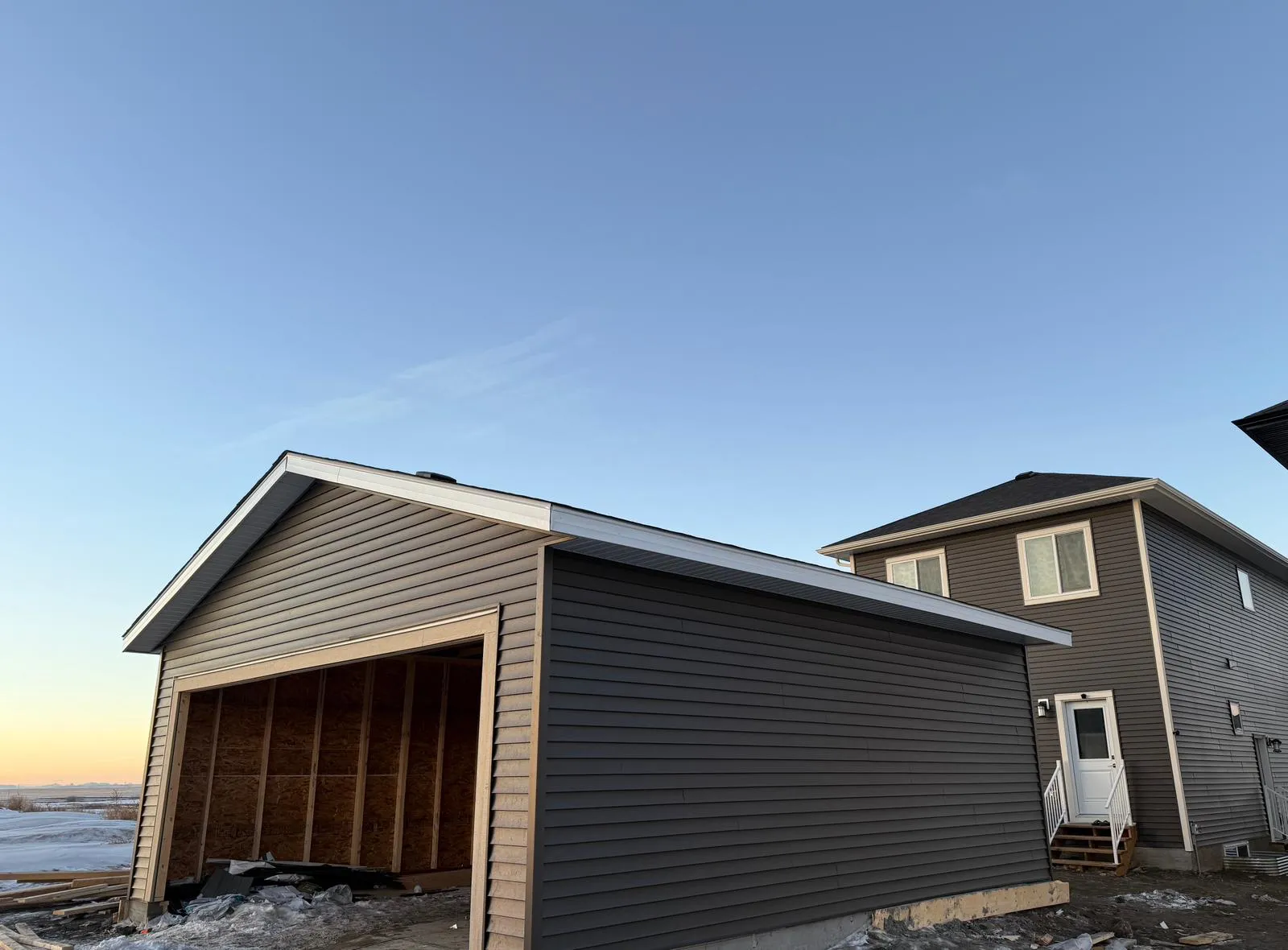
We also do garages and outbuildings, which are routinely built without eavestrough at all. The result is a trench of runoff along the base of the wall, an undermined pad edge, and a lane or yard that ices over every winter where the water crosses it.
Eavestroughs across Calgary & Central Alberta
Plus: Acme, Aldersyde, Ardenode, Arrowwood, Balzac, Banff, Bassano, Benchlands, Bergen, Black Diamond, Blackfalds, Blackie, Bottrel, Bowden, Carbon, Caroline, Carseland, Cayley, Champion, Cheadle, Claresholm, Cluny, Cochrane Lake, Conrich, Cremona, Dalroy, Dead Man's Flats, Delacour, Delburne, Dewinton, Dickson, Dogpound, Eckville, Eden Valley, Elbow Valley, Elnora, Ensign, Exshaw, Ghost Lake, Gleichen, Harmony, Harvie Heights, Heritage Pointe, Hussar, Huxley, Indus, Irricana, James River Bridge, Janet, Kananaskis Village, Kathyrn, Lac des Arcs, Linden, Longview, Lyalta, Madden, Markerville, Millarville, Milo, Morley, Morrin, Mossleigh, Munson, Namaka, Nightingale, Parkland, Penhold, Pine Lake, Priddis, Priddis Greens, Queenstown, Red Deer Lake, Redwood Meadows, Rocky Mountain House, Rockyford, Rosebud, Siksika Nation, Springbrook, Spruce View, Standard, Stavely, Swalwell, Torrington, Trochu, Tsuut'ina Nation, Turner Valley, Vulcan, Waiparous, Water Valley, Wimborne — and the surrounding Rocky View, Foothills, Mountain View, Wheatland, Kneehill and Red Deer county acreages.
Questions
Seamless Eavestroughs FAQ
What does 'seamless' actually mean?
+
The trough is rolled from a coil of aluminum on our truck and cut to the exact measured length of each run, so there are no joints along the run itself — only at corners and downspout outlets, which are sealed and riveted. Sectional gutter from a store has a joint every ten feet, and joints are where eavestroughs leak, clog and freeze open.
Should I get 5-inch or 6-inch eavestrough?
+
It depends on roof area, pitch and how the water concentrates. Five-inch suits most Calgary bungalows and standard two-storeys. Six-inch moves roughly 40% more water and is right for large roof areas, steep pitches, long runs with few downspouts, and acreage homes. If your existing clean troughs overflow in a heavy summer rain, the problem is capacity, not slope.
How much does seamless eavestrough cost?
+
It varies with total linear footage, the number of storeys, trough size, downspout count, and whether fascia repair is needed first. We measure and give an itemized quote after seeing the home. It is also one of the cheapest things to add to a roof replacement, since the crew, disposal and access are already there.
How far should downspouts discharge from the house?
+
A minimum of about 1.8 metres, and further on a lot sloping back toward the house. Calgary's clay soils swell and shrink dramatically with moisture, and concentrating roof runoff at the base of a wall is the most efficient way to stress a foundation. Missing or removed extensions are the most common cause of a wet basement we see.
Can eavestroughs be installed in winter?
+
Yes. Aluminum forms and hangs fine in cold weather, so eavestrough is one of the few exterior trades that runs comfortably year-round here. Sealant needs appropriate temperature handling, which we plan for.
Will new eavestroughs stop my ice dams?
+
No, and anyone who says otherwise is selling the wrong fix. Ice dams are caused by heat escaping into the attic, melting roof snow that refreezes at the cold eave. Clogged or badly pitched troughs make the ice mass worse, so correcting them helps — but the actual fix is attic ventilation and insulation, which we also handle.
What colour options are there?
+
A wide stock aluminum range, selected to match your fascia, soffit, trim and roof. Because we form on site and also install soffit and fascia, we can match the whole eave line as one detail rather than three products in three near-misses.
Do you replace the fascia if it's rotten?
+
Yes, and we check before quoting. Eavestrough hangers fasten into the fascia, and hanging new trough on soft wood guarantees doing the job twice. If the fascia or sub-fascia is gone, it gets replaced first.
Do you do eavestroughs on garages and outbuildings?
+
Yes, and they are routinely missing entirely. A garage without eavestrough sheds a trench of runoff along the base of its wall, undermines the pad edge and ices the lane every winter. It is a small job with a disproportionate effect.
How often will they need cleaning?
+
Twice a year in Calgary — after the spring melt and poplar fluff, and in late fall once the leaves are down. Three times under heavy conifer cover. The autumn clean is the important one: a trough full of wet leaves in November freezes solid, and that ice is what tears trough and fascia off a house.
Related services
We also handle
Our work
Seamless Eavestroughs & more
Free inspection
Get your eavestroughs quote
No pressure · No surprises
Ready to move on your eavestroughs project?
Free on-site inspection, honest written quote, and full insurance-claim support if you need it.