

Siding · Calgary & Area
Vinyl Siding
Vinyl and insulated vinyl siding — the biggest visual change per dollar, hung so it can actually move
Siding
Vinyl Siding done right, the first time.
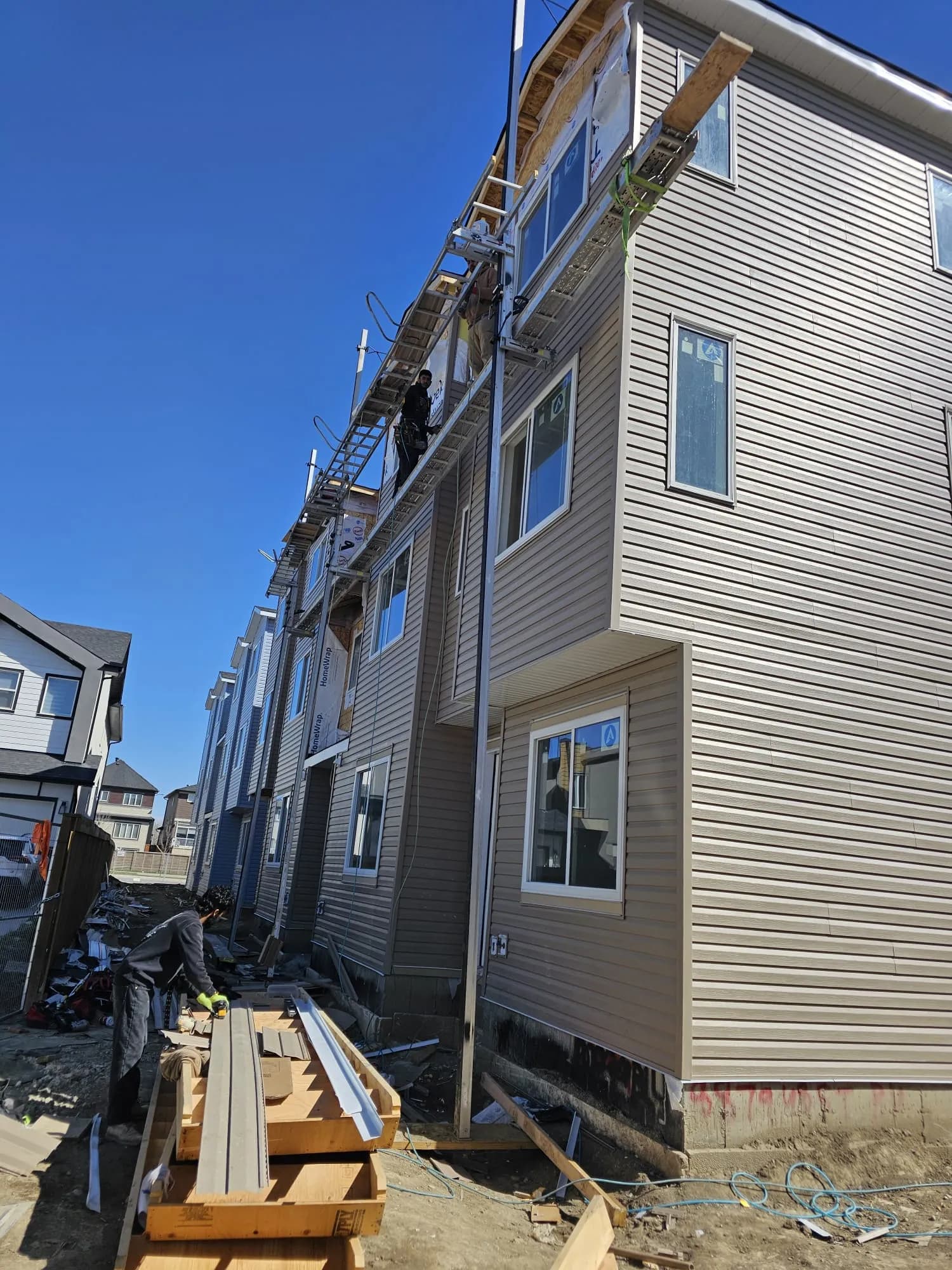
Vinyl siding is the fastest, most cost-effective way to change how a house reads from the street — and, installed correctly, a genuinely durable exterior in this climate. We install standard and insulated vinyl from premium warrantied lines, correct the water-resistive barrier and flashing behind it while the wall is open, and hang the panels so they can move through a 60-degree annual temperature swing without buckling.
More about vinyl siding
Built for Calgary's weather & homes.
Vinyl siding covers more Calgary houses than any other cladding, and for straightforward reasons: it is the least expensive way to completely change a home's appearance, it needs nothing beyond an annual rinse, it comes in a colour range no other product matches, and modern panels carry genuine fade and hail warranties. For a homeowner looking at a chalky, faded 1980s exterior, nothing else delivers as much visible improvement per dollar spent.
The catch is that vinyl is unforgiving of bad installation in a way that few materials are. It expands and contracts noticeably with temperature, and Calgary swings sixty degrees across a year and thirty in an afternoon when a chinook arrives. Panels nailed tight instead of allowed to float will buckle in the first hot week. Panels butted hard at the ends will oil-can. It costs nothing extra in material to do this correctly — only attention — which is precisely why it is the detail cheap crews get wrong.
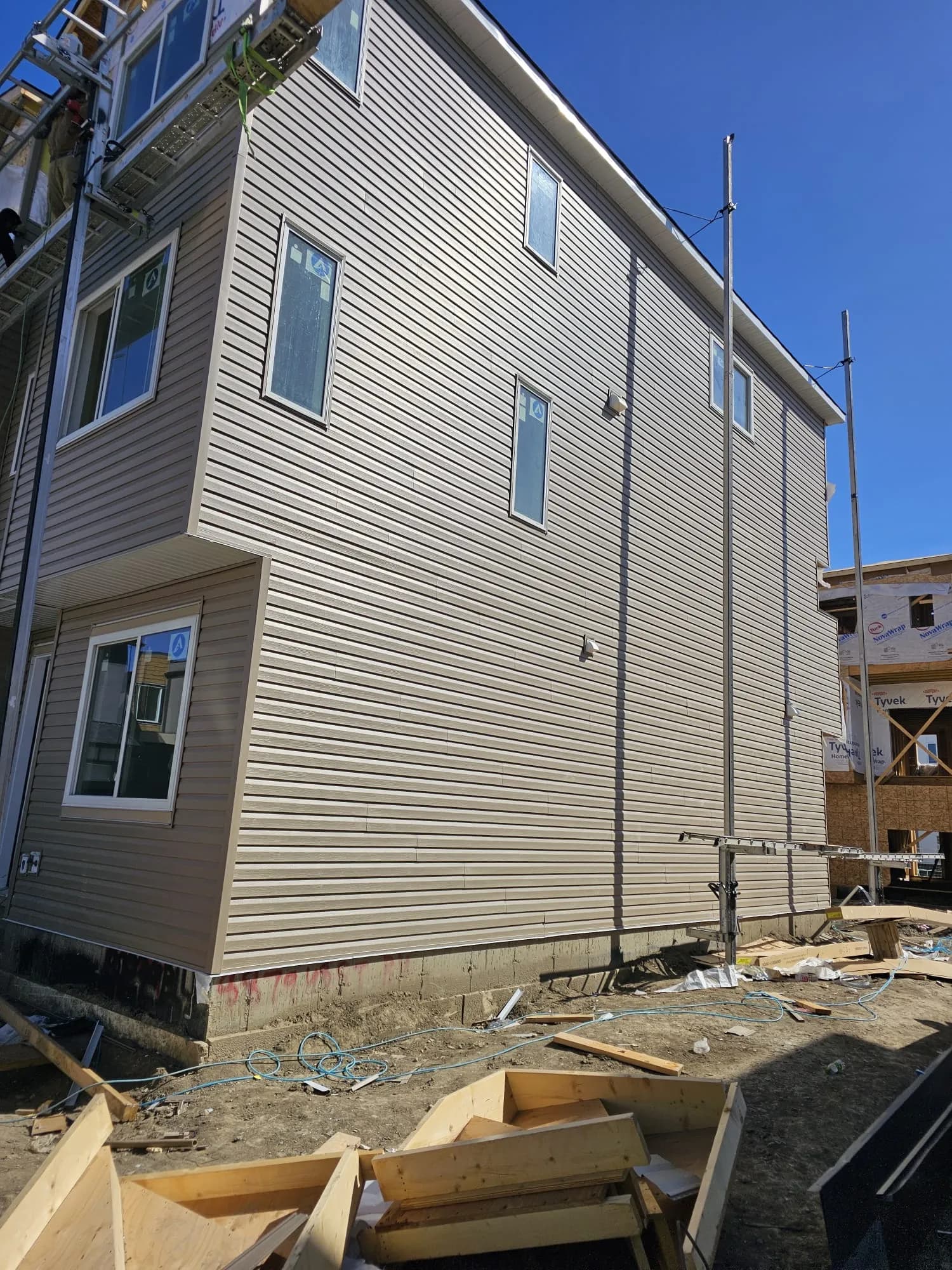
7 Lucky Enterprises installs standard and insulated vinyl across Calgary and Central Alberta, on houses, detached garages and acreage outbuildings. We are licensed, insured and WCB-covered, we inspect the existing wall assembly before quoting rather than pricing per square foot over the phone, and we back the installation with a written workmanship warranty on top of the manufacturer's material coverage.
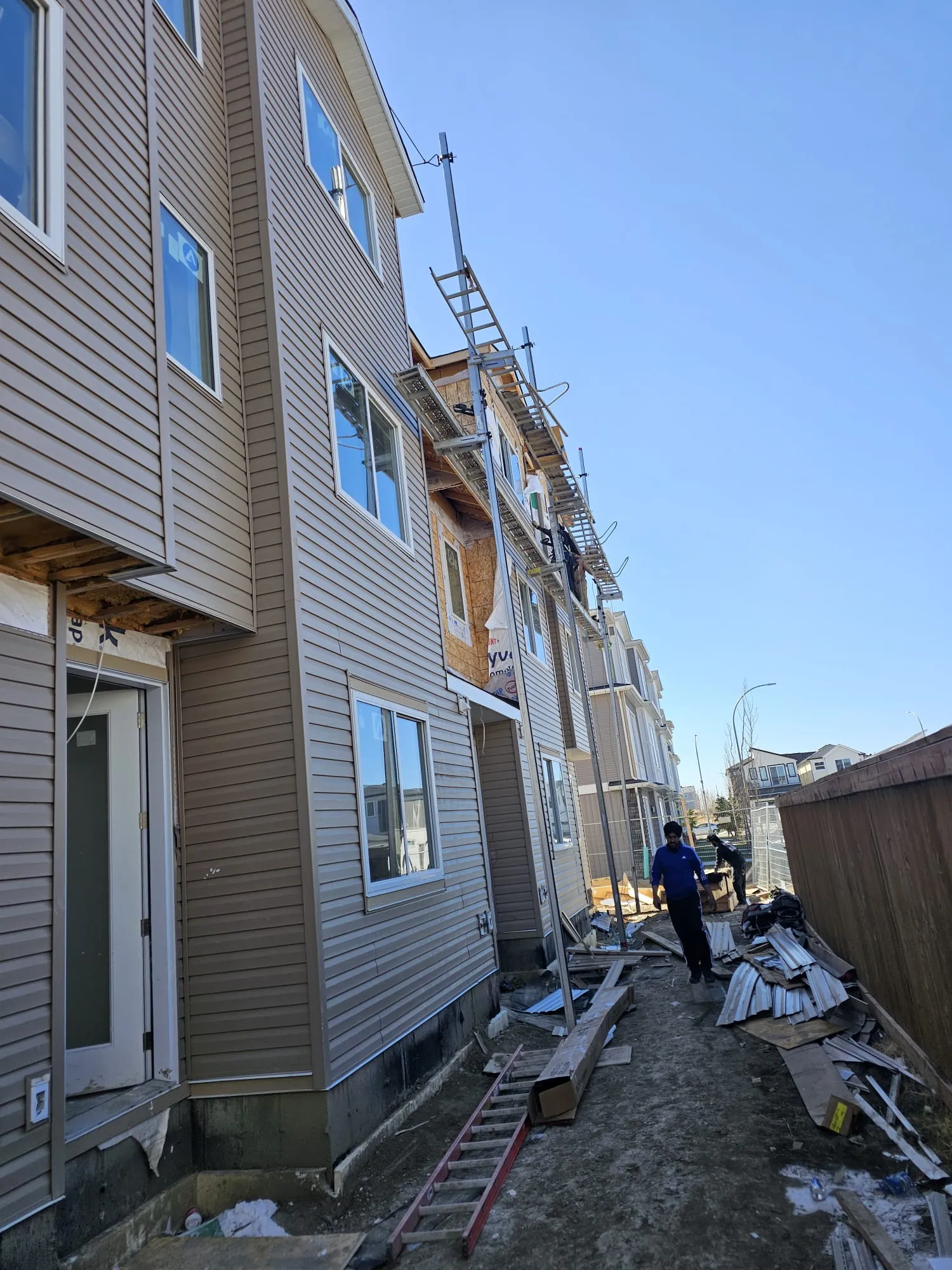
Insulated vinyl is worth understanding as a separate product rather than an upsell. A contoured expanded-polystyrene backer is laminated to the back of each panel, filling the void behind it. That raises the wall's effective R-value, dampens sound noticeably, makes the panel far more rigid and impact-resistant, and eliminates the hollow sound standard vinyl makes when you knock on it. In a climate with real heating costs it is a defensible upgrade rather than a cosmetic one.
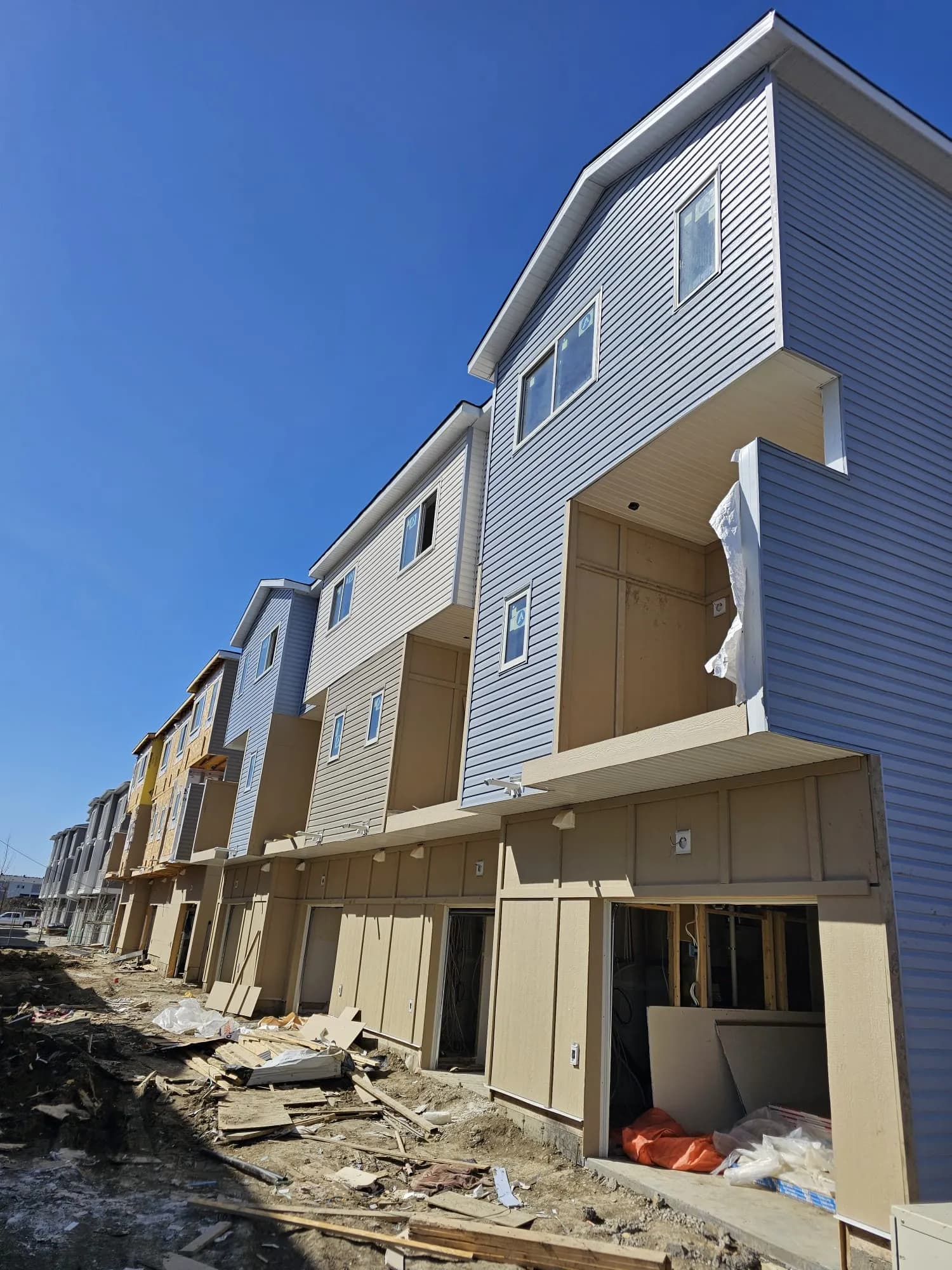
Because we also roof and install eavestroughs, we look at the whole envelope at once. Cracked siding under a downspout usually means that downspout has been discharging against the wall for years. Rotten trim below a roof edge usually means a drip edge or flashing problem above it. Replacing the visible symptom without addressing the cause is how a homeowner pays for the same wall twice.
The full guide
Everything worth knowing about vinyl siding in Alberta.
Standard vinyl or insulated vinyl?
Standard vinyl is a hollow extruded PVC panel that locks to the course below it and is nailed through a slot into the sheathing. It is light, quick to install, available in every profile and colour, and the least expensive cladding on the market. Panel thickness matters more than people realize — heavier gauge holds its shape better, resists warping, and looks straighter across a long elevation. We do not install builder-grade thin panel because it is a false economy that shows within five years.
Insulated vinyl adds a shaped foam backer bonded to the panel. The practical differences are immediate: the panel is far more rigid, so it lies flatter and straighter on an uneven wall; it is significantly more impact-resistant, which matters directly in hail country; it deadens exterior sound; and it adds meaningful R-value to a wall assembly that in most older Calgary homes has very little.
The trade-off is cost — insulated typically runs a substantial premium over standard — and slightly more labour, since it is thicker and heavier to work. Whether that premium pays back depends on how long you are staying and how cold the wall currently is. For a 1970s or 1980s home with minimal wall insulation, the case is strong. For a rental being prepared for sale, standard vinyl in a heavier gauge is usually the rational choice.
One thing neither product does is take paint reliably, so colour is a permanent decision. Choose against the roof colour, the trim and the street rather than against a sample chip in a showroom, and look at the sample outdoors — Calgary's high-altitude light reads colour differently from indoor lighting.
- Heavier gauge panel — resists warp and reads straighter
- Insulated backer adds R-value, rigidity and impact resistance
- Full profile range — horizontal lap, Dutch lap, vertical board and batten, shakes
- Fade and hail warranties on premium lines
- Colour is permanent — vinyl does not take paint reliably
What we do to the wall before the siding goes on
Almost every siding failure we are called to fix turns out to be a failure of the layers behind the cladding. Siding is a rain screen, not a waterproof membrane — it sheds the bulk of the water and the assembly behind it manages the rest. That assembly is the water-resistive barrier, the flashing at every opening, and a drainage path that lets incidental moisture escape.
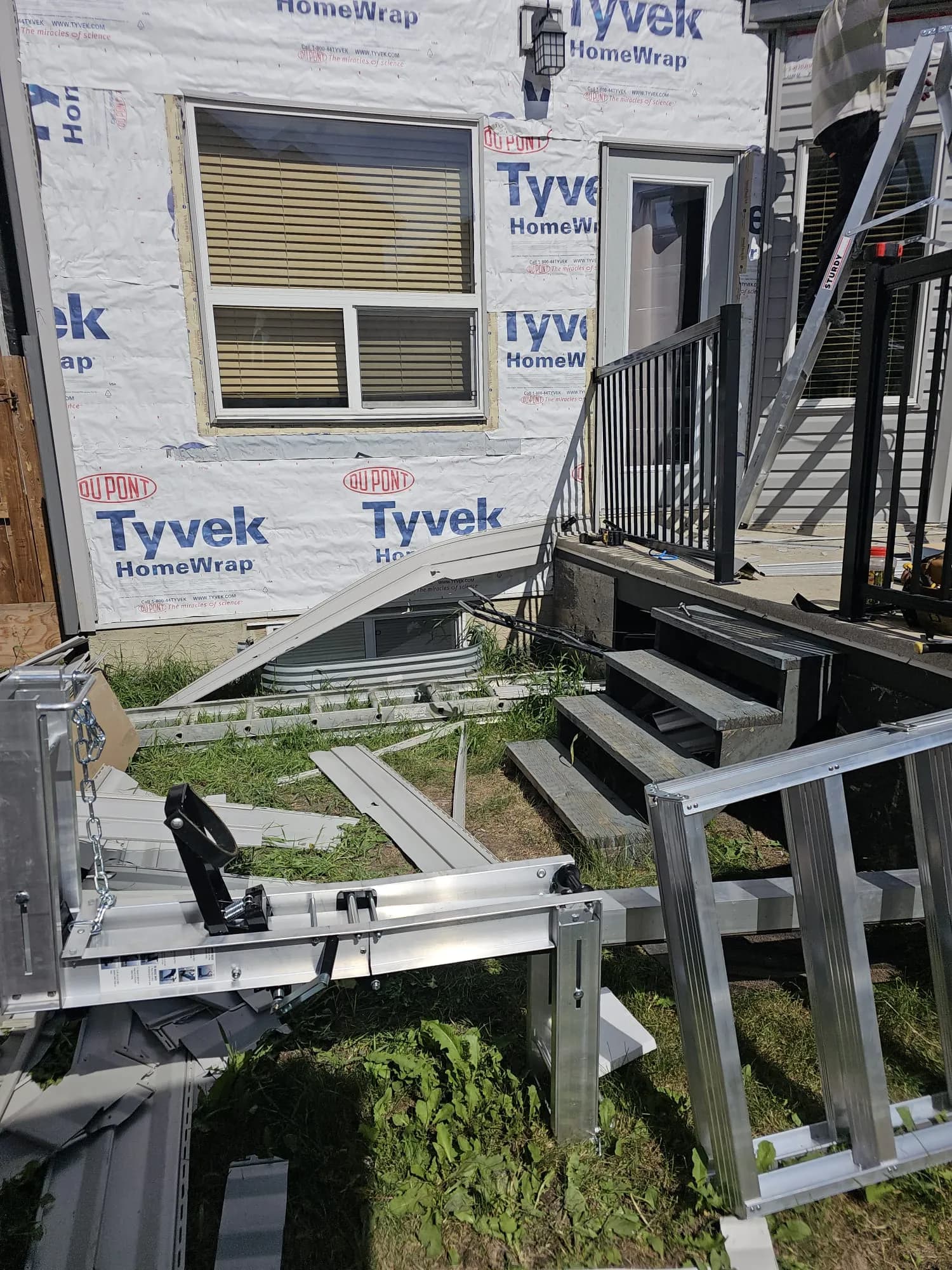
So when the old cladding comes off, we inspect. Sheathing gets checked for rot and delamination, particularly low on the wall, under windows, and anywhere a downspout has been discharging. House wrap gets checked for tears, for reverse laps where an upper sheet was tucked behind a lower one, and for whether it was ever properly integrated with the window flashing at all — in a lot of older Calgary construction it was not.
Window and door openings are the highest-risk detail. Head flashing above openings is frequently missing entirely on homes built before it became standard practice, and the sill pan below is missing more often still. Both are cheap to add with the wall open and effectively impossible to add later.
Then the transitions: where cladding meets the roof, where it meets the foundation, where two materials meet at a storey line, and where a deck ledger penetrates the wall. Those junctions are where water actually gets in, and they are what we photograph and show you before covering them up.
Doing this correctly during a re-side costs a fraction of what it costs afterwards. Once the new cladding is on, reaching that layer means taking it all off again — which is the strongest argument for using a contractor who inspects before quoting rather than pricing from the curb.
Installing vinyl so it survives a chinook
Vinyl moves. A twelve-foot panel changes length measurably between a February morning at minus thirty and a July afternoon at plus thirty, and the entire installation method exists to accommodate that.
Fasteners go in the centre of the nailing slot, not the end, and are driven so the panel hangs rather than clamps — roughly a credit-card thickness of play between the nail head and the flange. A nail driven tight turns a floating panel into a fixed one, and the panel will buckle at the first hot week or split at the first deep cold.
Ends need clearance. Panels are cut short of the receiving channel by a specified amount — more in cold weather than warm, because the panel is at its shortest when you install it in winter and will grow. Butted tight, it has nowhere to go but outward, which is the visible waviness people call oil-canning.
Starter strips have to be level, because every course above inherits the error. Corners, J-channel and window surrounds have to be set so water sheds outward at every junction rather than being caught behind a flange. And on gables and high elevations, the panel needs enough fastening frequency to resist chinook uplift without being over-fastened.
None of this costs extra material. It costs attention, and it is the whole difference between a vinyl exterior that looks straight in fifteen years and one that looks wavy in three.
Vinyl and hail — the honest picture
Vinyl's weakness in this region is impact in cold weather. PVC becomes progressively more brittle as temperature drops, so a hailstorm in May or September does far more damage to vinyl than the same storm in July. Damage shows as cracks and punctures, usually on the lower half of a panel where it is least supported, and usually concentrated on the elevation facing the storm.
That damage is frequently missed. A homeowner files a hail claim for the roof, the adjuster approves the roof, and the siding never gets inspected — until the house is sold and a home inspector lists every cracked panel. If hail hit hard enough to bruise your shingles, it very likely hit the walls facing the storm.
Cracks in vinyl are also easy to miss visually because they are hairline and only show in raking light. We inspect the walls at the same time as the roof, photograph what we find, and include it in the same claim scope — which is materially easier for an adjuster to approve than a separate submission months later.
If you are re-siding in a high-exposure area, insulated vinyl is the meaningful upgrade: the foam backer supports the panel across its full face, which substantially raises the impact energy required to crack it. Where hail exposure is the dominant concern and budget allows, fibre cement is the stronger answer, and we will tell you that rather than sell you the product with the better margin.
Cost, timeline and what to expect
Vinyl siding is one of the most budget-friendly ways to reface a home, but the final price varies with the size and height of the house, how much trim and architectural detail it carries, whether you choose standard or insulated panels, and what condition the sheathing and barrier underneath turn out to be in. We quote after seeing the home in person so the number reflects your actual project rather than a guess.
The variables that move the price most: total wall area including gables, the number of storeys — a three-storey elevation needs staging that a bungalow does not — the number of windows, doors, corners and transitions, each of which is trim work rather than field work, and whether existing cladding has to come off or the house is a new build.
A typical Calgary bungalow re-side runs a few days on site; a large two-storey or an acreage home with substantial gable area takes a week or more. Weather is the wildcard, since vinyl is best not installed in deep cold when it is brittle and hardest to cut cleanly.
Disruption is modest compared with roofing. There is noise, there are ladders or scaffolding around the house, and interior wall vibration when fasteners go in, but you can live normally throughout. We protect landscaping, keep the site tidy daily, and finish with a full cleanup and walkthrough.
Vinyl siding across Calgary and Central Alberta
Re-siding demand here clusters by era. Late-1970s and 1980s subdivisions — Ranchlands, Whitehorn, Marlborough, Beddington, Woodbine, Acadia, Pineridge — are on original or first-replacement cladding that has now taken forty years of high-altitude UV and gone chalky and brittle. Early-2000s suburbs are reaching the age where builder-grade thin panel has faded unevenly and cracked at the corners.
We work all of them, in every Calgary quadrant, and out through Airdrie, Chestermere, Cochrane, Okotoks, High River, Langdon, Strathmore, Crossfield, Carstairs, Didsbury, Olds, Innisfail, Red Deer, Sylvan Lake, Canmore, Beiseker, Three Hills, Drumheller, Nanton and Diamond Valley.
Acreage siding is a different specification again. A country-residential home has no neighbouring buildings breaking the wind, so driven rain and snow hit the wall assembly directly and far harder than on a sheltered city lot. Fastening frequency, flashing detail and material choice all shift accordingly, and we specify against the actual exposure rather than a standard detail.
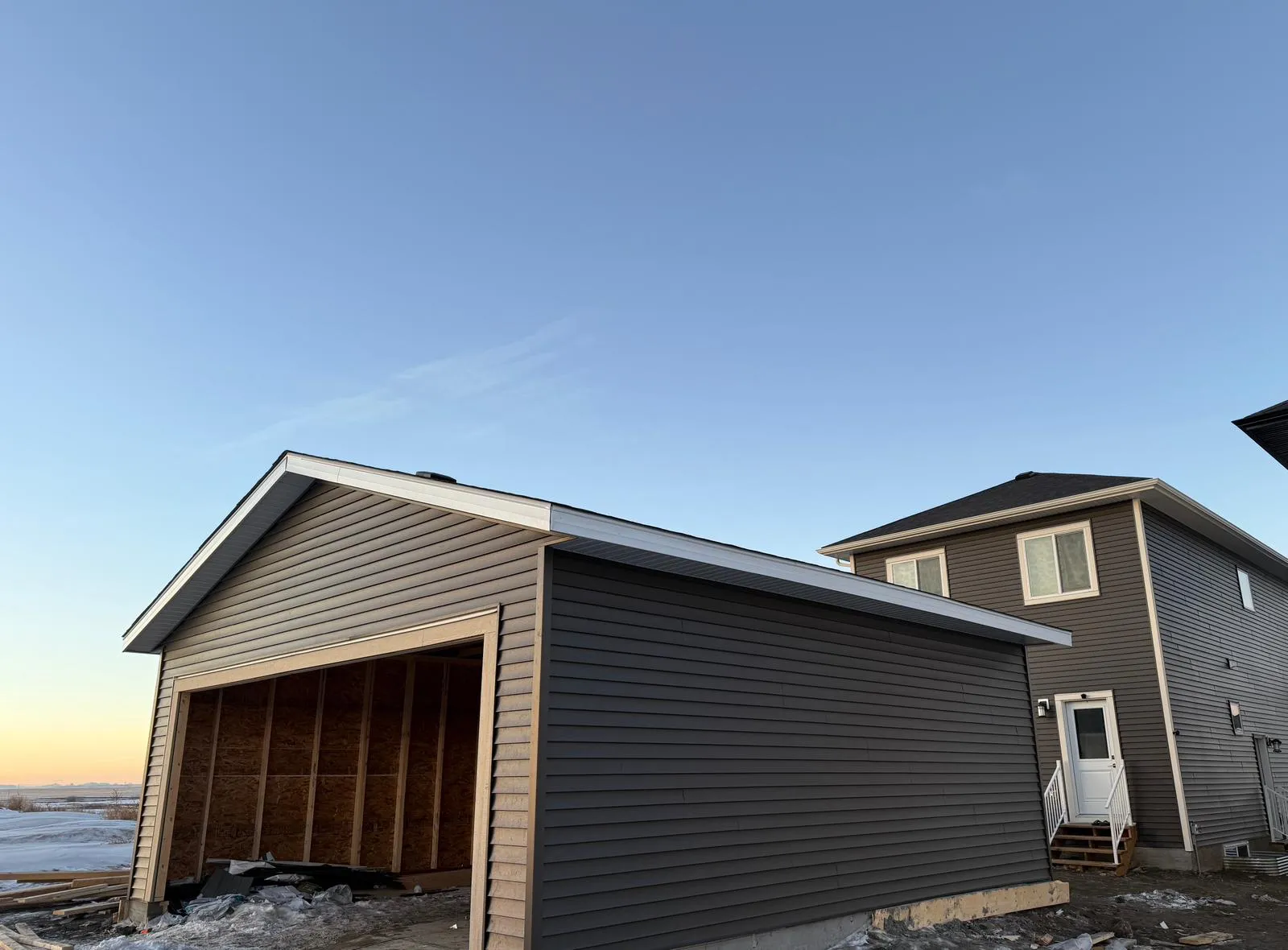
And we side garages. Matching the detached garage to the house during a re-side costs far less than doing it as a separate job later, and it is what makes the back of a property read as finished rather than as an afterthought.
Vinyl Siding across Calgary & Central Alberta
Plus: Acme, Aldersyde, Ardenode, Arrowwood, Balzac, Banff, Bassano, Benchlands, Bergen, Black Diamond, Blackfalds, Blackie, Bottrel, Bowden, Carbon, Caroline, Carseland, Cayley, Champion, Cheadle, Claresholm, Cluny, Cochrane Lake, Conrich, Cremona, Dalroy, Dead Man's Flats, Delacour, Delburne, Dewinton, Dickson, Dogpound, Eckville, Eden Valley, Elbow Valley, Elnora, Ensign, Exshaw, Ghost Lake, Gleichen, Harmony, Harvie Heights, Heritage Pointe, Hussar, Huxley, Indus, Irricana, James River Bridge, Janet, Kananaskis Village, Kathyrn, Lac des Arcs, Linden, Longview, Lyalta, Madden, Markerville, Millarville, Milo, Morley, Morrin, Mossleigh, Munson, Namaka, Nightingale, Parkland, Penhold, Pine Lake, Priddis, Priddis Greens, Queenstown, Red Deer Lake, Redwood Meadows, Rocky Mountain House, Rockyford, Rosebud, Siksika Nation, Springbrook, Spruce View, Standard, Stavely, Swalwell, Torrington, Trochu, Tsuut'ina Nation, Turner Valley, Vulcan, Waiparous, Water Valley, Wimborne — and the surrounding Rocky View, Foothills, Mountain View, Wheatland, Kneehill and Red Deer county acreages.
Questions
Vinyl Siding FAQ
How much does vinyl siding cost in Calgary?
+
Vinyl is one of the most budget-friendly ways to reface a home, but the price varies with the size and height of the house, how much trim and detail it has, whether you choose standard or insulated panels, and the condition of the sheathing underneath. We quote after seeing the home in person, so the number reflects your actual project rather than a guess.
Is insulated vinyl siding worth the extra cost?
+
Often, in this climate. The foam backer adds real R-value to walls that in most older Calgary homes have very little, makes the panel far more rigid so it lies flatter, deadens sound, and substantially raises the impact energy needed to crack it in hail. For a 1970s or 1980s home you plan to keep, the case is strong. For a property you are preparing to sell, heavier-gauge standard vinyl is usually the rational choice.
How long does vinyl siding last here?
+
Premium panels installed correctly commonly run 25 to 40 years. What ends them early is UV fade on cheap thin panel, impact damage from hail, and installation that did not allow for expansion — buckled and wavy siding is almost always an install problem, not a material one.
Can vinyl siding be installed in winter?
+
It can, but it is not ideal. PVC becomes brittle in deep cold, which makes it harder to cut cleanly and easier to crack when handling. Alberta winters usually offer enough chinook windows to keep exterior work moving, and we will schedule around the material rather than force a bad install.
Can I paint vinyl siding if I change my mind about the colour?
+
Not reliably. Vinyl expands and contracts far more than paint film tolerates, and darker paint on a panel not engineered for it can cause warping. Treat the colour as permanent, and choose it outdoors against your roof and trim rather than under showroom lighting.
Does hail damage vinyl siding?
+
Yes, particularly in cool weather when PVC is more brittle. Damage shows as hairline cracks and punctures, usually low on a panel and concentrated on the storm-facing elevation, and it is easy to miss because it only shows in raking light. If hail hit your roof, we inspect the walls at the same time and include what we find in the same claim scope.
Do I need to remove the old siding first?
+
We do, and we recommend it. Removing the old cladding is the only opportunity to see and fix the sheathing, the water-resistive barrier and the window flashing behind it. Siding over top hides everything and guarantees that any existing water problem keeps running unseen.
How do I clean and maintain vinyl siding?
+
An annual rinse with a garden hose and a soft brush, working bottom to top and rinsing top to bottom. Avoid high-pressure washing, which can drive water up behind the panels and into the wall assembly. That is genuinely the whole maintenance routine.
Will you match my soffit, fascia and eavestroughs?
+
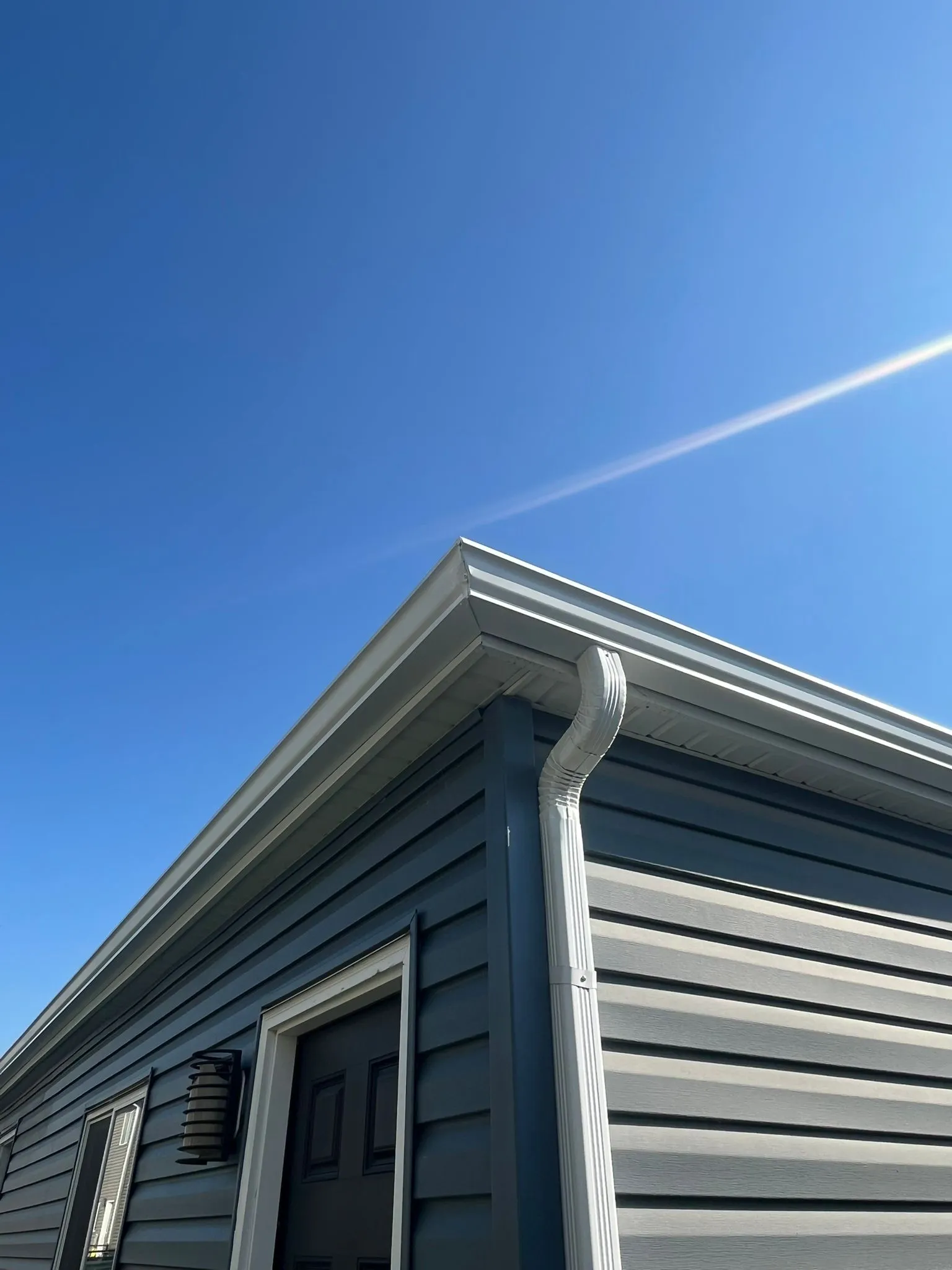
Yes, and it is the cheapest moment to do it. Soffit, fascia, trim and eavestrough are all part of the same visual line, and replacing them together while the crew is mobilized gives a coherent result for far less than doing them separately.
Do you side detached garages?
+
Yes, and bundling the garage with a house re-side costs significantly less than booking it later. It is also what makes the back of a property look finished rather than mismatched.
Related services
We also handle
Our work
Vinyl Siding & more
Free inspection
Get your vinyl siding quote
No pressure · No surprises
Ready to move on your vinyl siding project?
Free on-site inspection, honest written quote, and full insurance-claim support if you need it.